

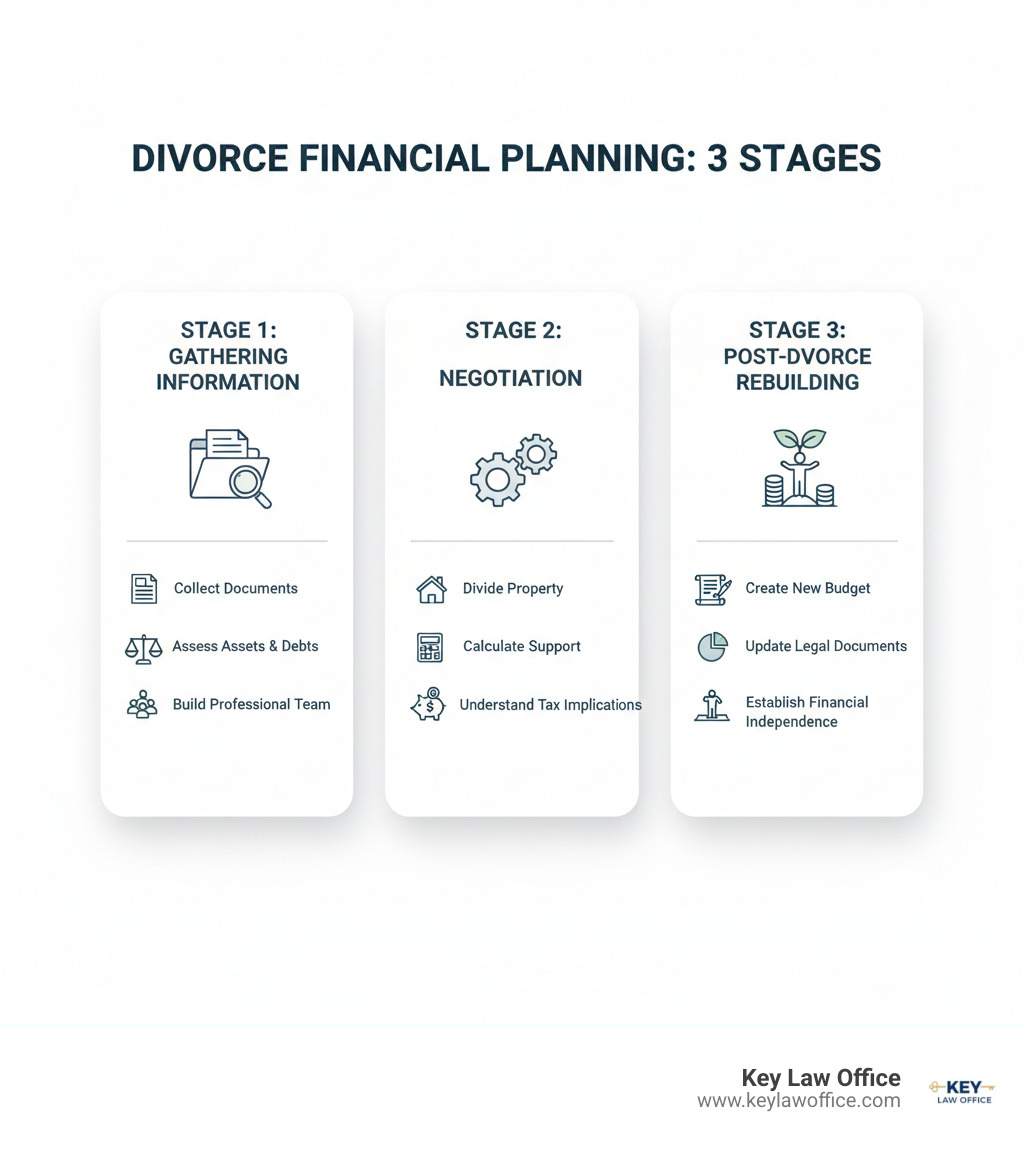
Divorce financial planning means getting a clear, documented picture of everything you and your spouse own and owe, sorting out what Texas law treats as community or separate property, and testing each settlement option against your life after the decree. In a Texas divorce, you can break it into three steps: build your financial picture, protect and classify your property, and plan the division with taxes, support, and your post-divorce budget in mind.
Divorce is an emotional event, but the settlement itself is mostly a financial transaction. The decisions you make over a few months will shape your housing, your retirement, and your cash flow for years. This handbook walks through each step the way we approach it with clients at Key Law Office, with the Texas rules that apply along the way.
Why the money side deserves early attention
The stakes are real at every age, and they’re often highest later in life. According to the Pew Research Center, the divorce rate for U.S. adults 50 and older has roughly doubled since the 1990s. If you’re divorcing in your 50s or 60s, there’s less time to rebuild savings before retirement, so each decision about the house, the 401(k), or a pension carries more weight.
Two households also cost more to run than one. A second rent or mortgage, a second set of utilities, separate insurance, and duplicate costs for the kids add up quickly. The earlier you understand your numbers, the stronger your negotiating position, because you can tell the difference between an offer that looks fair on paper and one that actually works for your budget.
Texas law also builds in some planning time. Under Texas Family Code §6.702, a court generally can’t grant a divorce until at least 60 days after the petition is filed, and contested cases usually take longer. Use that window to get organized instead of waiting for the other side to set the agenda.
Step 1: Build a complete financial picture
Everything else depends on this step. Make copies of your financial records, store them somewhere your spouse can’t reach, such as a personal email account, and give a set to your attorney. Here is what to gather:
- Tax returns for the last three to five years, with W-2s, 1099s, and K-1s. They reveal side income, rental income, business profits, and investment activity.
- Bank and credit card statements for 12 to 24 months. Look for transfers to accounts you don’t recognize, large cash withdrawals, or spending you can’t explain.
- Retirement and investment statements, ideally going back to the date of marriage. Older statements help prove which part of an account belonged to you before the wedding.
- Deeds, vehicle titles, mortgage statements, and loan documents for every property and every debt.
- Insurance policies for life, health, disability, home, and auto coverage, including beneficiary designations and any cash value.
- Pay stubs and equity statements for bonuses, stock options, restricted stock units, and deferred compensation.
Then build a monthly budget showing what you spend now and what you expect to spend on your own. That number matters for support, for deciding whether you can afford to keep the house, and for your life after the case.
In a Texas divorce, this work isn’t optional busywork. While the case is pending, Family Code §6.502 lets the court order each spouse to prepare a sworn inventory and appraisement listing all property, debts, and values. Because it’s signed under oath, an incomplete inventory can damage your credibility. If a spouse hides or wastes community assets, the court can find fraud on the community under §7.009 and award the other spouse a larger share of a reconstituted estate.
Building your professional team
Your divorce lawyer handles the legal strategy: classifying property, negotiating, drafting the decree, and representing you in court. For many families, a Certified Divorce Financial Analyst (CDFA) adds a second lens by projecting how each settlement option plays out over 5, 10, or 20 years.
| Role | Divorce Lawyer | Certified Divorce Financial Analyst (CDFA) |
|---|---|---|
| Primary Focus | Legal strategy, court representation, drafting agreements | Financial analysis, long-term planning, budget projections |
| Key Services | Negotiating settlements, filing legal documents, protecting your legal rights | Analyzing settlement options, projecting financial outcomes, creating post-divorce budgets |
| When You Need Them | From the beginning of divorce proceedings through finalization | During settlement discussions and for long-term financial planning |
| Background | Family law, court procedures, legal precedents | Financial planning, tax implications, retirement planning |
In more complex cases, the team may also include a forensic accountant to trace money or test reported income, and a business valuator if either spouse owns a company. Your attorney can help you decide whether those added costs make sense for your situation.

Step 2: Protect and classify your property
Texas is a community property state. Under Family Code §3.003, property either spouse has during the marriage or at divorce is presumed to be community property, and a spouse claiming something as separate has to prove it by clear and convincing evidence. Separate property, defined in §3.001, includes what you owned before marriage, what you received during marriage by gift or inheritance, and certain personal injury recoveries.
That burden of proof is why old statements matter. If you had $40,000 in a 401(k) on your wedding day, you’ll need records that trace that money through the years, or the court may treat the whole account as community property. Tracing is often where separate property claims are won or lost. A valid premarital agreement can change these default rules, so it’s one of the first documents your attorney will review.
Keeping things stable while the case is pending
Once a divorce is filed, the rules about money change. Courts can issue temporary restraining orders and temporary injunctions to preserve property (Family Code §§6.501 and 6.502). Many Texas counties, including Travis County, also apply a standing order to new divorce cases that limits withdrawals and transfers from financial accounts and bars cancelling a spouse’s credit. Read any order that applies to you before making a large purchase or moving money.
A few practical steps protect you during this period:
- Pull your free credit reports and list every joint account and loan.
- Keep paying joint debts on time. A divorce decree doesn’t bind your creditors, so a missed payment on a joint card hurts both credit scores no matter what the decree says.
- Don’t move, spend, or hide community funds outside normal living expenses.
- Open a checking account and a credit card in your own name if you don’t already have them.
Step 3: Plan the division with taxes, retirement, and support in mind
Texas courts divide the community estate in a manner the court considers just and right under Family Code §7.001. That doesn’t always mean 50/50. Judges can weigh factors such as each spouse’s earning capacity, health, fault in the breakup, and who will care for the children. Our article on the Texas just and right division rule shows how those factors play out.
This is the step where an experienced Austin divorce lawyer earns their keep, because the dollar values on a spreadsheet rarely tell the whole story. Two assets with the same balance can be worth very different amounts after taxes and timing.
Not every dollar is worth the same
Retirement accounts. A $100,000 401(k) is pre-tax money, so it’s worth less to you than $100,000 in a savings account. Dividing an employer plan usually requires a qualified domestic relations order (QDRO), and the court that signed your decree keeps jurisdiction to issue one under Family Code §9.101. Payments to a former spouse under a QDRO avoid the 10% early withdrawal penalty, though income tax still applies. Pensions such as the Teacher Retirement System of Texas follow their own rules, and our guide to dividing a TRS pension or family business explains how they’re handled.
Brokerage accounts. Transfers between spouses as part of a divorce generally aren’t taxed at the time of transfer under federal tax law, but the receiving spouse takes over the original cost basis. A $100,000 account with $60,000 in built-in gains will cost more in taxes when sold than $100,000 in cash.
The house. Keeping the home can feel like the safe choice, but it comes with the mortgage, taxes, insurance, and repairs on one income. If you sell later as a single filer, the federal capital gains exclusion on a primary home is generally $250,000 instead of $500,000 for a married couple. You’ll also usually need to refinance, because the lender won’t release your spouse from the loan just because the decree awards you the house.
Texas has no state income tax, but federal rules still apply. For divorce agreements signed after 2018, spousal maintenance isn’t deductible for the payer or taxable to the person receiving it.
Support you may pay or receive
Child support in Texas follows guideline percentages in Family Code §154.125: 20% of the paying parent’s net resources for one child, 25% for two, and 40% for five, with six or more children set at no less than the five-child amount. The guidelines apply to monthly net resources up to $11,700 (the cap that took effect September 1, 2025), and a court can order more above that amount based on a child’s proven needs.
Spousal maintenance is narrower than many people expect. Under Chapter 8 of the Family Code, a spouse generally has to show they’ll lack enough property to meet their minimum reasonable needs, plus a qualifying factor such as a marriage of 10 years or more combined with an inability to earn enough income. Court-ordered maintenance is capped at the lesser of $5,000 a month or 20% of the paying spouse’s average monthly gross income (§8.055), and it usually has a time limit tied to the length of the marriage. Spouses can agree to contractual alimony beyond those limits. Our spousal support page covers how courts decide.
Your financial checklist after the decree
The decree ends the case, but the financial work continues for a few more months.
Retitle everything the decree awards you, including vehicles, the house deed, and investment accounts, and confirm that any QDRO has actually been submitted to and approved by the plan.
Update your beneficiary designations. Texas law generally cancels a former spouse’s designation as a life insurance beneficiary after divorce (Family Code §9.301) and revokes will provisions in their favor (Estates Code §123.001), but federal rules can override state law for some employer plans. Updating each form yourself avoids surprises.
Rewrite your estate plan. A new will, financial power of attorney, and medical power of attorney make sure the right people are in charge if something happens to you.
Live on the new budget for 90 days, then adjust. Track what you actually spend, and rebuild an emergency fund before taking on new debt.
Talk with a divorce attorney about your plan
You don’t need every answer before you call. If you’d like help putting your financial picture together, or want a second look at a proposed settlement, our divorce attorneys work with families from our offices in Austin, Buda, Bastrop, New Braunfels, and Victoria. A free consultation is a calm place to start.
Frequently asked questions
What is divorce financial planning?
Divorce financial planning is the process of gathering your financial records, identifying and valuing every asset and debt, and testing settlement options against your budget, taxes, and retirement so the agreement you sign works for your life after the divorce.
Is everything split 50/50 in a Texas divorce?
No. Texas courts divide community property in a way that is just and right under Family Code §7.001, which can mean an unequal split based on factors like earning capacity, health, fault, and who cares for the children. Separate property is not divided.
How do I prove that property is my separate property?
Texas presumes property is community property, so you need clear and convincing evidence. That usually means documents such as account statements, deeds, gift letters, or inheritance records that trace the property back to before the marriage or to a gift or inheritance.
What happens if my spouse hides assets during the divorce?
Hidden assets often surface through the sworn inventory, subpoenaed records, or a forensic accountant. If the court finds fraud on the community, it can calculate what the estate would have been worth and award the wronged spouse a larger share under Family Code §7.009.
Do I need a financial analyst as well as a lawyer?
Not always. A lawyer is essential for the legal side of the case. A Certified Divorce Financial Analyst can help when there are retirement accounts, a pension, a business, or a decision about keeping the house that needs long-range projections.
Should I keep the house in my divorce?
Only if you can afford it on your own income and can refinance the mortgage into your name. Compare the full monthly cost of the home, including taxes, insurance, and repairs, with the other assets you would give up to keep it.