
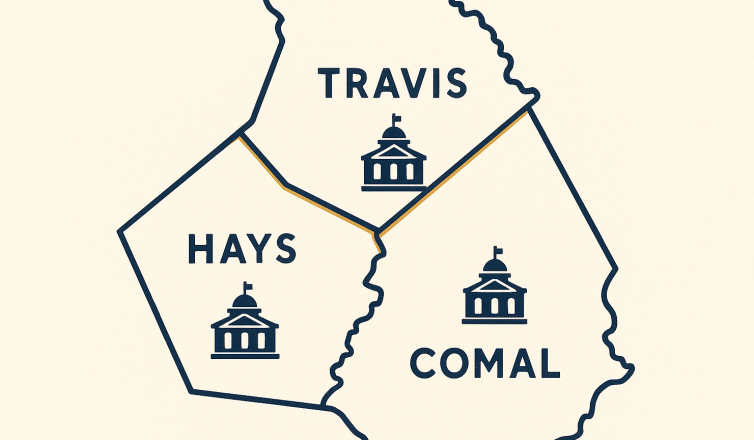
The county where you file for divorce will not change the law that applies to your case, but it can change how the case actually feels in practice. Travis, Hays, and Comal County all follow the same Texas family law, yet each courthouse runs its own routine. Here is what stays the same and what shifts in the divorce process when you cross a county line in Central Texas.
Key Takeaways
- The Texas Family Code applies in every county, so the core rules of a divorce do not change when you move from Travis to Hays to Comal.
- Texas residency requirements: you must have lived in Texas for at least six months and in the county for at least 90 days before you file (Tex. Fam. Code § 6.301).
- Travis County issues an automatic standing order the moment you file. Hays County asks you to attach its standing order to the petition.
- Filing fees, the family bench, and parenting-class expectations differ by county even though the statute reads the same.
- The first step in any Texas divorce is the same: file the petition for divorce with the district clerk where you meet residency.
- Filing in the right court, the right way, the first time keeps your case on schedule, and a local divorce lawyer knows each courthouse’s habits.

How filing for divorce in Texas works the same in every county
Filing for divorce in Texas follows the same Texas Family Code in every county. The residency requirements, the 60 day waiting period, the community-property and property division rules, and the grounds for divorce do not change from Travis to Hays to Comal. What changes county to county is the local administrative routine: the clerk, the standing order, and the judges who hear your family law case.
Here is the part that surprises people. The statute is statewide, so a divorce in Texas reads the same whether you live in Austin or New Braunfels. Texas law treats the state as community property, which means assets you and your spouse acquired during the marriage are generally split through property division the court calls “just and right” (Tex. Fam. Code §§ 3.002, 7.001). The most common ground is insupportability, a no-fault basis that simply means the marriage can no longer work. Fault grounds such as cruelty, adultery, and abandonment also exist under Tex. Fam. Code §§ 6.001 through 6.007.
So if the family law is identical, why does the county matter when you file for divorce? Because the courthouse is where the law meets paperwork, schedules, and people. That is where Travis, Hays, and Comal start to differ once you actually file for divorce.
Where you file for divorce in Texas: residency and venue
Under Texas Family Code § 6.301, the residency requirements say at least one spouse must have lived in Texas for the previous six months and in the county of filing for the previous 90 days before you can file for divorce. When spouses live in different counties, either spouse’s qualifying county can be a proper venue for the divorce petition, which gives some couples a real choice about where the case starts.
These residency requirements mean more than an address. They point to domicile, the place you treat as your fixed home and intend to return to. The “at least one spouse” rule matters too. Only one of you needs to meet both the state and county thresholds, so a recent move does not always block you from where you want to file for divorce. Couples who never had a ceremony file the same way, but if the marriage was informal, be ready to prove it, starting with the three elements Texas uses to recognize a common law marriage. You can read the rule yourself at Tex. Fam. Code § 6.301.
Tie this to where you live. A Buda resident generally files in Hays County, a New Braunfels resident in Comal County, and an Austin resident in Travis County. Families on the northern edge of the metro sometimes meet residency in Williamson County instead, which runs its own family courts in Georgetown. If you moved out and your spouse stayed put, the county can hinge on which of you cleared the 90 days mark. That single fact often decides which courthouse and which judges handle the case, so it is worth getting right before you file your petition for divorce.
Filing in Travis County: the district clerk, e-filing, and the automatic standing order
In Travis County you file the Original Petition for Divorce with the Travis County District Clerk’s Family Division in downtown Austin, either electronically through eFileTexas or in person. The moment you file, Travis County issues an automatic standing order that bars both spouses from hiding assets, canceling insurance, or disrupting the children’s routine while the case is pending.
That automatic order is the headline difference. In some counties you have to request similar protections during the divorce process. In Travis County they attach to your case the day the divorce petition is stamped, and both spouses are bound by them. The Travis County District Clerk’s Family Division handles the filing, assigns a cause number, and routes contested matters through a central docket where available judges hear hearings as the calendar allows (Travis County District Clerk).
One practical note for Austin filers. Attorneys must use e-filing for civil and family law cases in Texas, so most people who file for divorce move the petition through the eFileTexas portal rather than a paper trip to the clerk’s office. If you are filing on your own, the Travis County Law Library offers review resources for self-represented filers.
Filing in Hays County: San Marcos courthouse and the standing-order attachment rule
In Hays County you file your divorce with the Hays County District Clerk at the Government Center in San Marcos. Unlike Travis, Hays County local rules ask you to attach a copy of the county standing order to the Original Petition when you file. Cases with minor children must also complete a parent-education program before the divorce is finalized.
That attachment step is small but easy to miss. Forget it, and the clerk’s office may flag your filing or the court may not treat the protections as in place. The Hays County family bench runs through the 22nd, 207th, 428th, and 453rd district courts, so your case lands with one of those courts and the judge who sits there. Knowing that rotation ahead of time helps you anticipate how scheduling and temporary orders tend to move.
This is home turf for our team. Tyler Key is a Hays County native, so he knows the San Marcos courthouse routine firsthand, from the clerk’s filing habits to how the local courts handle a contested temporary-orders hearing. For anyone searching hays county divorce, the law matches Travis, but the front-end paperwork and the parent-education requirement are where Hays asks a little more of you up front.
Filing in Comal County: New Braunfels courts and local forms
In Comal County you file your divorce with the Comal County District Clerk in New Braunfels, where your case is assigned to one of the county’s five district courts (the 22nd, 207th, 274th, 433rd and 466th), all of which sit in New Braunfels. New Braunfels courts use their own local forms and cover-sheet expectations, so it is worth confirming that your petition and final decree track the Texas Family Code exactly before filing.
Comal shares some district courts with neighboring counties, so the same judge may sit in more than one county on different days, which can affect when your matter is heard. Local cover sheets and intake forms also differ from Travis or Hays, so a form that worked in one county is not always the form the New Braunfels clerk wants. Checking the current Comal County District Clerk requirements before you file saves a return trip. After filing, the first hearing many New Braunfels families face is a temporary orders hearing, and we explain how Comal County temporary orders hearings work and how to prepare.
Bastrop County rounds out the firm’s four-county footprint. Bastrop divorces are filed with the Bastrop County District Clerk and since early 2025 new family cases there have been assigned to the 465th District Court, a smaller docket than the Austin metro courts. Parents who divorced in Austin and later moved to Bastrop should know that the Travis County court usually keeps a custody case until it is transferred to Bastrop. Wherever you file, the lesson holds: anyone searching comal county divorce will find the statute identical, while the forms and the bench are local.
From petition for divorce to final decree: the filing steps
A Texas divorce moves from the Original Petition through service, the 60 day waiting period, optional temporary orders, financial disclosure, and finally a prove-up or trial where the judge signs the final decree. The statutory steps are identical in every county. Only the clerk who stamps the filing and the judge who signs the decree change from one courthouse to the next.
Here is the path most cases follow:
- Prepare and file the Original Petition for Divorce, the petition for divorce that opens the case, with the district clerk in your county.
- Pay the filing fee, or request a waiver if you cannot afford payment.
- Serve the other spouse, or have them sign a waiver of service.
- Calendar the mandatory 60 day waiting period, which the court counts from the filing date (Tex. Fam. Code § 6.702).
- Request temporary orders if you need support, use of the home, or a parenting schedule while the case is pending.
- Exchange financial information through discovery if the case is contested.
- Draft the final decree, the document that spells out the terms.
- Attend the prove-up hearing or trial.
- The judge signs the final decree, and the divorce decree becomes effective.
Spousal maintenance, the court-ordered spousal support that can continue after the divorce, has its own eligibility rules under Tex. Fam. Code Ch. 8. Dividing the marital estate can also get technical: retirement benefits often need a separate qualified domestic relations order, and a request for temporary support during the case keeps bills covered while the divorce is pending. The final decree is what locks all of those terms in once the judge signs.
Serving divorce papers
After you file, the other spouse has to receive official notice. You can have a constable, the sheriff, or a private process server hand-deliver the divorce papers, or the other spouse can sign a waiver of service. Whichever route you take, proof of service gets filed with the court so the case can move forward toward the final hearing.
Uncontested vs contested: how each county handles agreed cases
An uncontested divorce, sometimes called an agreed divorce, is one where you and your spouse settle every issue. After the 60 day waiting period, an uncontested divorce often ends with a short prove-up and a divorce decree the judge signs that day. If you are wondering how the wait itself works, our guide to what happens during the 60 days after you file walks through each stage. A contested divorce, by contrast, runs the divorce proceedings through discovery, temporary-orders hearings, and possibly trial. Every Central Texas county handles agreed cases, but the local docket and judge tendencies shape how quickly a contested divorce reaches a hearing.
Filing fees and fee waivers by county
Texas divorce filing fees vary by county and change periodically. In Travis County the filing fee runs roughly $258 without children and $273 with children, plus about $8 for a service citation. Hays and Comal County fees should be confirmed directly with each district clerk, and a fee waiver for the court fees is available if you cannot afford payment.
Those Travis figures come from published Travis County clerk schedules, but court fees and court costs move over time, so always verify the current filing fee with the clerk’s office before you write the check. Adding minor children usually nudges the fee higher because the petition asks the court to address custody and support. The county where you file for divorce sets its own court costs and court fees, which is one more reason the courthouse, not just the statute, shapes your out-of-pocket start.
If you cannot afford the filing fee
If the filing fee is out of reach, Texas lets you file a Statement of Inability to Afford Payment of Court Costs under Texas Rule of Civil Procedure 145. You describe your income, expenses, and any benefits you receive, and the court can waive the fees. Legal-aid organizations and resources at TexasLawHelp.org can walk you through the form if money is tight.
When children are involved: county parenting requirements
Child custody, which Texas calls conservatorship, possession, and access, plus child support, follows statewide Family Code guidelines no matter which county hears the case. Child support is calculated as a percentage of the paying parent’s net resources under Tex. Fam. Code Ch. 154, and a child custody schedule follows the Standard Possession Order unless the parents agree otherwise. What differs by county is parenting-class and mediation expectations. Hays County requires a parent-education program for cases with minor children, while Travis County may call for parenting resources in certain cases.
Adding minor children also changes some forms and raises the filing fee, because the court now has to decide a parenting schedule and support alongside the divorce. If you and your spouse can agree on the parenting plan, many counties favor mediation before a contested hearing. If you cannot, the local family court steps in. Whatever county you are in, getting the children’s arrangements right matters more than the form numbers, which is the heart of filing for divorce in Central Texas when kids are involved.
Working with a divorce lawyer who knows all four counties
A divorce lawyer who regularly files in Travis, Hays, Comal, Bastrop, and Williamson County knows each courthouse’s clerk routine, judge tendencies, and local-rule quirks. That local familiarity keeps a divorce case on schedule, because the same family law statute gets administered a little differently depending on which Central Texas courthouse you walk into. A divorce lawyer who only works one county can be caught off guard by another county’s standing-order or form rules.
Key Law Office files family cases in all four county district court systems, with offices in Austin, Buda, Bastrop, and New Braunfels. Tyler Key, the managing attorney, is a Hays County native with around 12 years of experience and Super Lawyers Rising Star recognition, and he has served as both Guardian ad Litem and Amicus Attorney. With nine attorneys, including five partners, the firm can run cases across counties at the same time.
You do not have to sort out which court, which standing order, and which forms on your own. If you would like to talk through your situation, we offer free consultations. You can talk to a Central Texas divorce attorney about where and how to file, with no pressure to decide anything on the call.
Frequently asked questions
Does it matter which county you file for divorce in Texas?
The law is the same statewide, so the outcome rules do not change by county. What changes is the routine: the clerk’s office, the standing order, the filing fee, and the judges. Travis issues an automatic standing order, while Hays asks you to attach one. Those local differences can affect timing and paperwork.
Can I file in a different county than my spouse?
Sometimes, yes. Under Texas Family Code § 6.301, the residency requirements only ask that one spouse meet the six months state and 90 days county thresholds. If you and your spouse live in different qualifying counties, either of those counties can be where you file for divorce. Talk with an attorney about which choice fits your situation best.
How long does a Texas divorce take in Travis, Hays, or Comal County?
Every Texas divorce includes a mandatory waiting period of 60 days that the court counts from the date you file for divorce, so no case finalizes faster than that. Uncontested cases often wrap up shortly after the 60 days end. Contested cases that need discovery, hearings, or trial can take many months, depending on whether you filed in Travis, Hays, Comal, or Williamson County and how busy that docket is.
What should I not do after filing for divorce in Texas?
Do not hide or move assets, cancel a spouse’s insurance, or disrupt the children’s routine, especially where a standing order is in place, as it is automatically in Travis County. Avoid large purchases, deleting financial records, or hostile messages. When in doubt, ask your attorney before you act so you stay on the right side of the court’s orders.